
ALANNO: An Active Learning Annotation System for Mortals
In Proceedings of the 17th Conference of the European Chapter of the Association for Computational Linguistics: System Demonstrations, pages 228–235, Dubrovnik, Croatia. Association for Computational Linguistics.
Abstract
Supervised machine learning has become the cornerstone of today’s data-driven society, increasing the need for labeled data. However, the process of acquiring labels is often expensive and tedious. One possible remedy is to use active learning (AL) – a special family of machine learning algorithms designed to reduce labeling costs. Although AL has been successful in practice, a number of practical challenges hinder its effectiveness and are often overlooked in existing AL annotation tools. To address these challenges, we developed ALANNO, an open-source annotation system for NLP tasks equipped with features to make AL effective in real-world annotation projects. ALANNO facilitates annotation management in a multi-annotator setup and supports a variety of AL methods and underlying models, which are easily configurable and extensible.
Introduction
Machine learning models rely heavily on labeled data, which is often expensive to obtain. Active Learning (AL) can reduce labeling costs by selecting the most informative instances for labeling. ALANNO addresses practical issues in AL application, supporting multi-annotator projects and ensuring unbiased evaluation and robust label quality.
System Overview
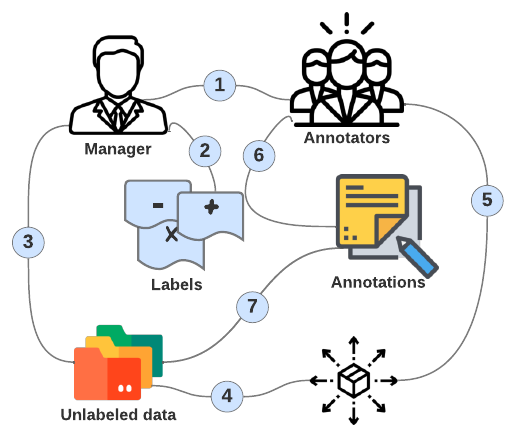
ALANNO organizes annotation projects into manageable components, including project roles (managers and annotators), data assignment, and annotation. Data assignments are managed incrementally in rounds, and project managers can adjust annotators and workload per round. The interface supports single-label and multi-label classification, as well as sequence labeling tasks.
Features
Annotation Management
ALANNO supports balanced data assignment through a Quasi-Monte Carlo method and monitors inter-annotator agreement using various metrics. It offers agreement-aware label aggregation, allowing for quality control across diverse annotators with varying expertise levels.
AL Acquisition Models and Functions
The system offers a variety of acquisition models (TF-IDF, SVM, Transformers) and AL methods (uncertainty sampling, informative density). ALANNO’s flexible architecture supports the inclusion of new models and acquisition functions, enabling efficient data sampling in AL processes.
AL Challenges and Solutions
To address AL challenges, ALANNO includes methods for unbiased evaluation (by reserving a test set), a performance forecasting tool for the stopping criterion, and guided learning to manage class imbalance.
Case Studies
Two case studies demonstrate ALANNO’s balanced data assignment and performance forecasting features. The first study highlights balanced assignment benefits using Quasi-Monte Carlo methods, while the second showcases forecasting for efficient AL processes.
Related Work
ALANNO builds upon previous annotation tools like Label Studio and INCEpTION, but uniquely addresses key practical AL challenges in multi-annotator setups. This distinguishes ALANNO from other AL tools, offering features specifically designed for real-world application and label reliability improvement.
Conclusion
ALANNO is a comprehensive, open-source AL-based annotation tool for NLP tasks. It addresses essential challenges of AL and annotation management in real-world projects, offering a practical solution to improve data quality and reduce labeling costs.
BibTeX
@inproceedings{jukic-etal-2023-alanno,
    title = "{ALANNO}: An Active Learning Annotation System for Mortals",
    author = "Juki{\'c}, Josip  and
      Jeleni{\'c}, Fran  and
      Bi{\'c}ani{\'c}, Miroslav  and
      \v{S}najder, Jan",
    editor = "Croce, Danilo  and
      Soldaini, Luca",
    booktitle = "Proceedings of the 17th Conference of the European Chapter of the Association for Computational Linguistics: System Demonstrations",
    month = may,
    year = "2023",
    address = "Dubrovnik, Croatia",
    publisher = "Association for Computational Linguistics",
    url = "https://aclanthology.org/2023.eacl-demo.26",
    doi = "10.18653/v1/2023.eacl-demo.26",
    pages = "228--235",
    abstract = "Supervised machine learning has become the cornerstone of today{'}s data-driven society, increasing the need for labeled data. However, the process of acquiring labels is often expensive and tedious. One possible remedy is to use active learning (AL) {--} a special family of machine learning algorithms designed to reduce labeling costs. Although AL has been successful in practice, a number of practical challenges hinder its effectiveness and are often overlooked in existing AL annotation tools. To address these challenges, we developed ALANNO, an open-source annotation system for NLP tasks equipped with features to make AL effective in real-world annotation projects. ALANNO facilitates annotation management in a multi-annotator setup and supports a variety of AL methods and underlying models, which are easily configurable and extensible.",
}
Keep reading
Related publications

Out-of-Distribution Detection by Leveraging Between-Layer Transformation Smoothness
Effective out-of-distribution (OOD) detection is crucial for reliable machine learning models, yet most current methods are limited in practical use due to requirements like access to training data or intervention in training. We present a novel method for detecting OOD data in Transformers based on transformation smoothness between intermediate layers of a network (BLOOD), which is applicable to pre-trained models without access to training data. BLOOD utilizes the tendency of between-layer representation transformations of in-distribution (ID) data to be smoother than the corresponding transformations of OOD data, a property that we also demonstrate empirically. We evaluate BLOOD on several text classification tasks with Transformer networks and demonstrate that it outperforms methods with comparable resource requirements. Our analysis also suggests that when learning simpler tasks, OOD data transformations maintain their original sharpness, whereas sharpness increases with more complex tasks.

On Dataset Transferability in Active Learning for Transformers
Active learning (AL) aims to reduce labeling costs by querying the examples most beneficial for model learning. While the effectiveness of AL for fine-tuning transformer-based pre-trained language models (PLMs) has been demonstrated, it is less clear to what extent the AL gains obtained with one model transfer to others. We consider the problem of transferability of actively acquired datasets in text classification and investigate whether AL gains persist when a dataset built using AL coupled with a specific PLM is used to train a different PLM. We link the AL dataset transferability to the similarity of instances queried by the different PLMs and show that AL methods with similar acquisition sequences produce highly transferable datasets regardless of the models used. Additionally, we show that the similarity of acquisition sequences is influenced more by the choice of the AL method than the choice of the model.

Context Parametrization with Compositional Adapters
Large language models (LLMs) often seamlessly adapt to new tasks through in-context learning (ICL) or supervised fine-tuning (SFT). However, both of these approaches face key limitations: ICL is inefficient when handling many demonstrations, and SFT incurs training overhead while sacrificing flexibility. Mapping instructions or demonstrations from context directly into adapter parameters offers an appealing alternative. While prior work explored generating adapters based on a single input context, it has overlooked the need to integrate multiple chunks of information. To address this gap, we introduce CompAS, a meta-learning framework that translates context into adapter parameters with a compositional structure. Adapters generated this way can be merged algebraically, enabling instructions, demonstrations, or retrieved passages to be seamlessly combined without reprocessing long prompts. Critically, this approach yields three benefits: lower inference cost, robustness to long-context instability, and establishes a principled solution when input exceeds the model’s context window. Furthermore, CompAS encodes information into adapter parameters in a reversible manner, enabling recovery of input context through a decoder, facilitating safety and security. Empirical results on diverse multiple-choice and extractive question answering tasks show that CompAS outperforms ICL and prior generator-based methods, especially when scaling to more inputs. Our work establishes composable adapter generation as a practical and efficient alternative for scaling LLM deployment.

Disentangling Latent Shifts of In-Context Learning with Weak Supervision
In-context learning (ICL) enables large language models to perform few-shot learning by conditioning on labeled examples in the prompt. Despite its flexibility, ICL suffers from instability -- especially as prompt length increases with more demonstrations. To address this, we treat ICL as a source of weak supervision and propose a parameter-efficient method that disentangles demonstration-induced latent shifts from those of the query. An ICL-based teacher generates pseudo-labels on unlabeled queries, while a student predicts them using only the query input, updating a lightweight adapter. This captures demonstration effects in a compact, reusable form, enabling efficient inference while remaining composable with new demonstrations. Although trained on noisy teacher outputs, the student often outperforms its teacher through pseudo-label correction and coverage expansion, consistent with the weak-to-strong generalization effect. Empirically, our method improves generalization, stability, and efficiency across both in-domain and out-of-domain tasks, surpassing standard ICL and prior disentanglement methods.