
You Are What You Talk About: Inducing Evaluative Topics for Personality Analysis
Findings of the Association for Computational Linguistics: EMNLP 2022, pages 3986–3999, Abu Dhabi, United Arab Emirates. Association for Computational Linguistics.
Abstract
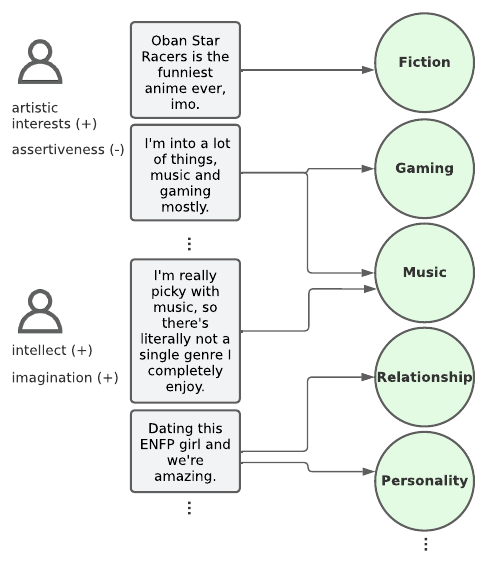
Expressing attitude or stance toward entities and concepts is an integral part of human behavior and personality. Recently, evaluative language data has become more accessible with social media’s rapid growth, enabling large-scale opinion analysis. However, surprisingly little research examines the relationship between personality and evaluative language. To bridge this gap, we introduce the notion of evaluative topics, obtained by applying topic models to pre-filtered evaluative text from social media. We then link evaluative topics to individual text authors to build their evaluative profiles. We apply evaluative profiling to Reddit comments labeled with personality scores and conduct an exploratory study on the relationship between evaluative topics and Big Five personality facets, aiming for a more interpretable, facet-level analysis. Finally, we validate our approach by observing correlations consistent with prior research in personality psychology.
Introduction
As researchers, we recognize that expressing opinions is fundamental to human behavior. With the explosion of social media, where users freely share their views, we now have unprecedented access to large amounts of evaluative text. In our study, we focus on analyzing evaluative language to see how it relates to personality traits. Specifically, we introduce the concept of “evaluative topics,” which are topics derived from opinionated text, and explore their relationship to the Big Five personality traits. By analyzing evaluative language on Reddit, we aim to provide insights into how people’s language reflects their personality at a more granular, facet level.
Methodology
Our methodology consists of three key steps:
- Evaluative Filtering: We first filter Reddit comments to extract those that contain evaluative language. To do this, we use a combination of sentiment analysis tools and evaluative expression lexicons to identify opinionated text.
- Topic Modeling: Next, we apply topic modeling to the filtered text. We experiment with several topic modeling techniques, including Latent Dirichlet Allocation (LDA), Biterm Topic Model (BTM), and a neural architecture for Attention-based Aspect Extraction (ABAE), to capture the underlying evaluative topics.
- Evaluative Profiling: Finally, we construct evaluative profiles for individual users by linking the evaluative topics to their text. These profiles allow us to study the relationships between evaluative language and personality facets.
Experiments
To validate our approach, we use the PANDORA dataset, which contains Reddit comments and self-reported Big Five personality scores. We build evaluative profiles for each user based on the filtered evaluative text and apply Canonical Correlation Analysis (CCA) to explore the relationship between the profiles and personality facets. Our experiments reveal significant correlations between evaluative topics and specific personality facets, supporting our hypothesis that the topics people discuss can reflect their underlying personality traits.
Results
Our results show that evaluative language is indeed linked to personality. We find notable correlations between topics like “music,” “fiction,” and “political issues” and facets such as openness to experience and neuroticism. Importantly, we demonstrate that filtering for evaluative text enhances the strength of these correlations compared to using unfiltered text. Our findings align with previous psychological research on personality and provide a novel way to study personality through language.
Conclusion
Through this study, we provide evidence that evaluative language offers valuable insights into personality traits. By linking evaluative topics to the Big Five facets, we offer a new method for personality analysis that could be useful for applications ranging from social media analysis to personalized recommendations. Our findings suggest that evaluative expressions carry significant informational value for understanding personality, and we believe this approach opens new avenues for further research on language and personality.
BibTeX
@inproceedings{jukic-etal-2022-talk,
    title = "You Are What You Talk About: Inducing Evaluative Topics for Personality Analysis",
    author = "Juki{\'c}, Josip  and
      Vukojevi{\'c}, Iva  and
      \v{S}najder, Jan",
    editor = "Goldberg, Yoav  and
      Kozareva, Zornitsa  and
      Zhang, Yue",
    booktitle = "Findings of the Association for Computational Linguistics: EMNLP 2022",
    month = dec,
    year = "2022",
    address = "Abu Dhabi, United Arab Emirates",
    publisher = "Association for Computational Linguistics",
    url = "https://aclanthology.org/2022.findings-emnlp.294",
    doi = "10.18653/v1/2022.findings-emnlp.294",
    pages = "3986--3999",
    abstract = "Expressing attitude or stance toward entities and concepts is an integral part of human behavior and personality. Recently, evaluative language data has become more accessible with social media{'}s rapid growth, enabling large-scale opinion analysis. However, surprisingly little research examines the relationship between personality and evaluative language. To bridge this gap, we introduce the notion of evaluative topics, obtained by applying topic models to pre-filtered evaluative text from social media. We then link evaluative topics to individual text authors to build their evaluative profiles. We apply evaluative profiling to Reddit comments labeled with personality scores and conduct an exploratory study on the relationship between evaluative topics and Big Five personality facets, aiming for a more interpretable, facet-level analysis. Finally, we validate our approach by observing correlations consistent with prior research in personality psychology.",
}
Keep reading
Related publications
Personality adjectives in the digital world: A natural language processing study of big five adjectives and their usage on reddit
Psycholexical studies explore the intricate interplay between language and personality traits, focusing on trait representation in language. One aspect of such representation is the frequency of personality adjective usage. This study examines how linguistic and trait-label properties of personality adjectives relate to their usage frequency. Utilizing a corpus from the social media platform Reddit, we employ natural language processing to analyze Big Five adjectives in person-descriptions. Our results show that trait-label properties exhibit different patterns when considered together rather than separately from linguistic properties—for instance, prefixal composition nullifies the expected effect of polarity on frequency. These findings highlight the importance of considering both linguistic and trait-label properties when assessing the usage of personality adjectives.
SIMPA: statement-to-item matching personality assessment from text
Automated text-based personality assessment (ATBPA) methods can analyze large amounts of text data and identify nuanced linguistic personality cues. However, current approaches lack the interpretability, explainability, and validity offered by standard questionnaire instruments. To address these weaknesses, we propose an approach that combines questionnaire-based and text-based approaches to personality assessment. Our Statement-to-Item Matching Personality Assessment (SIMPA) framework uses natural language processing methods to detect self-referencing descriptions of personality in a target’s text and utilizes these descriptions for personality assessment. The core of the framework is the notion of a trait-constrained semantic similarity between the target’s freely expressed statements and questionnaire items. The conceptual basis is provided by the realistic accuracy model (RAM), which describes the process of accurate personality judgments and which we extend with a feedback loop mechanism to improve the accuracy of judgments. We present a simple proof-of-concept implementation of SIMPA for ATBPA on the social media site Reddit. We show how the framework can be used directly for unsupervised estimation of a target’s Big 5 scores and indirectly to produce features for a supervised ATBPA model, demonstrating state-of-the-art results for the personality prediction task on Reddit.

Pandora talks: Personality and demographics on reddit
Personality and demographics are important variables in social sciences and computational sociolinguistics. However, datasets with both personality and demographic labels are scarce. To address this, we present PANDORA, the first dataset of Reddit comments of 10k users partially labeled with three personality models and demographics (age, gender, and location), including 1.6k users labeled with the well-established Big 5 personality model. We showcase the usefulness of this dataset on three experiments, where we leverage the more readily available data from other personality models to predict the Big 5 traits, analyze gender classification biases arising from psycho-demographic variables, and carry out a confirmatory and exploratory analysis based on psychological theories. Finally, we present benchmark prediction models for all personality and demographic variables.

Context Parametrization with Compositional Adapters
Large language models (LLMs) often seamlessly adapt to new tasks through in-context learning (ICL) or supervised fine-tuning (SFT). However, both of these approaches face key limitations: ICL is inefficient when handling many demonstrations, and SFT incurs training overhead while sacrificing flexibility. Mapping instructions or demonstrations from context directly into adapter parameters offers an appealing alternative. While prior work explored generating adapters based on a single input context, it has overlooked the need to integrate multiple chunks of information. To address this gap, we introduce CompAS, a meta-learning framework that translates context into adapter parameters with a compositional structure. Adapters generated this way can be merged algebraically, enabling instructions, demonstrations, or retrieved passages to be seamlessly combined without reprocessing long prompts. Critically, this approach yields three benefits: lower inference cost, robustness to long-context instability, and establishes a principled solution when input exceeds the model’s context window. Furthermore, CompAS encodes information into adapter parameters in a reversible manner, enabling recovery of input context through a decoder, facilitating safety and security. Empirical results on diverse multiple-choice and extractive question answering tasks show that CompAS outperforms ICL and prior generator-based methods, especially when scaling to more inputs. Our work establishes composable adapter generation as a practical and efficient alternative for scaling LLM deployment.